
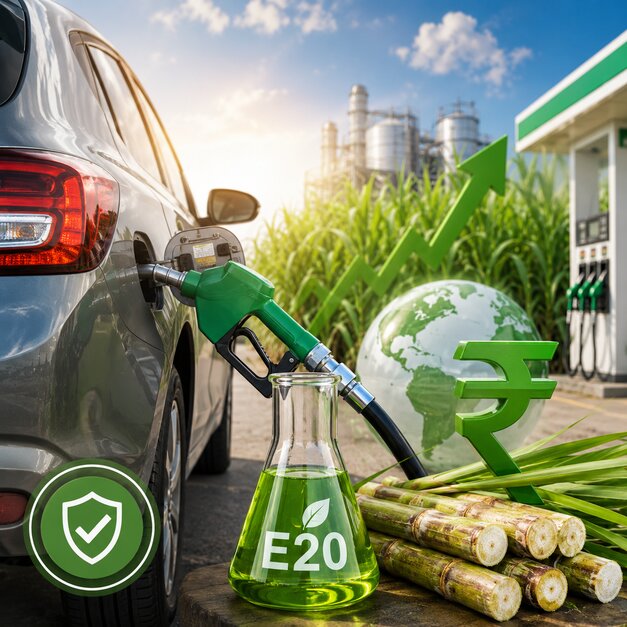
During the Monsoon Session of the Parliament, a question was asked whether the Government has conducted any research/study on the quantity of water consumed in the production of one litre of ethanol used for blending.
The Minister of State, MoPNG, said that the Government has adopted a balanced approach to the Ethanol Blended Petrol (EBP) Programme, ensuring that water sustainability, food security and farmers’ interests remain paramount.

Under the National Policy on Biofuels, ethanol is produced from a diversified basket of feedstocks, including sugarcane-based feedstocks, maize, damaged foodgrains, broken rice, foodgrains unfit for human consumption, surplus foodgrains approved by the National Biofuel Coordination Committee (NBCC) and other approved agricultural feedstocks.
This diversified approach reduces dependence on any single crop while improving feedstock
resilience. (contribution of maize towards ethanol blending has increased from 0% in ESY 21-22 to around 37% in ESY 25-26).
The Government is promoting crop diversification towards comparatively less water intensive feedstocks such as maize. An Expert Committee constituted by the Ministry of Agriculture & Farmers Welfare in 2024 examined the water requirement of various ethanol feedstock crops, and its recommendations are being considered while implementing the programme.
Water-use efficiency is also being enhanced through micro-irrigation, drip irrigation and other water conservation measures under the Per Drop More Crop component of the Pradhan Mantri Krishi Sinchayee Yojana. Many sugar mills are also encouraging farmers to adopt water-efficient cultivation practices.
Molasses-based distilleries with incineration boilers and grain-based distilleries are required to operate as Zero Liquid Discharge (ZLD) units, enabling recycling and reuse of process water while eliminating liquid effluent discharge. Modern ethanol plants typically consume about 3–5 litres of processed water for producing one litre of ethanol.
Ethanol is not a new fuel. It has been used globally for over a century, with countries such
as Brazil operating higher ethanol blends for decades. In India, the EBP Programme has been implemented through a phased, scientifically validated and consultative process involving NITI Aayog, automobile manufacturers, Oil Marketing Companies (OMCs), Automotive Research Association of India (ARAI), Society of Indian Automobile Manufacturers (SIAM), Indian Institute of Petroleum (IIP) and other technical institutions.
As seen from the table, the progression has been gradual:
Ethanol Supply Year Average Blending(%)
2013-14 ~1.53
2020-21 ~8.1
2021-22 ~10
2022-23 ~12
2023-24 ~14.6
2024-25 ~19.2
2025-26 (Nov-June) 20
India has achieved 20% ethanol blending five years ahead of the original target after more than two decades of phased policy development, stakeholder consultations, scientific evaluation and capacity creation.
The scientific studies, field validation and extensive real-world operating experience have shown that E20 is a safe, cleaner and technologically superior fuel when used in accordance with the prescribed specifications and manufacturer recommendations. The Government’s assessment is based not only on laboratory research but also on large-scale experience after nationwide implementation.
This is evident as E15+ blended petrol has been in widespread use for over three-and-a-half years and E19-E20 fuel for over two-and-a-half years. More than 20 crore two-wheelers and over 3 crore petrol cars have been operating on these blends without any verified evidence of widespread engine failure or vehicle breakdown attributable to ethanol blending. This is further validated through large-scale real- world experience. Manufacturer service data confirm that there is no abnormal corrosion, wear or reduction in vehicle life due to E20 fuel. Manufacturers continue to honour warranty obligations for vehicles using E20 fuel, providing further confidence in its safety and reliability.
One of the country’s largest passenger vehicle manufacturers serviced 2.84 crore vehicles during FY 2025–26, including approximately 1.5 crore older, non-E20-certified vehicles, without reporting any E20-related engine damage or abnormal component wear. Similarly, one of the leading two-wheeler manufacturers has reported, based on extensive service records, no higher incidence of damage in vehicles operating on E20 compared with earlier fuel blends.
The Government has not received any widespread or substantiated complaints from vehicle
manufacturers, automobile associations or consumer organisations regarding drastic reduction in mileage, slow pick-up and rusting of petrol tanks, attributable to E20 fuel. The Government has, however, taken note of certain concerns raised in media and social media, which have been scientifically examined.
Extensive laboratory testing and field validation by the Inter-Ministerial Committee under NITI Aayog, IOCL, ARAI, IIP and SIAM confirmed that E20 fuel does not cause abnormal wear and tear or compatibility issues.
With regard to mileage, studies by Government agencies and automobile manufacturers indicate that fuel efficiency is influenced by several factors, including driving conditions, driving habits and vehicle maintenance. Any reduction in fuel economy in certain E10-designed vehicles is generally limited to about 3-5%, while E20 offers a higher-octane rating, superior anti-knock characteristics, cleaner combustion and smoother engine performance.
Automobile manufacturers, component suppliers, SIAM, ARAI, testing agencies and Oil Marketing Companies were associated with every stage of the scientific evaluation and phased rollout of E20.
E20 was rolled out only after successful validation of fuel systems, engine durability, drivability, reasonable material compatibility and emissions performance. These studies also established that legacy vehicles do not exhibit any significant variation in performance or abnormal wear and tear due to E20.
According to SIAM and ARAI, E20 improves acceleration and ride quality while reducing carbon emissions. Ethanol’s higher-octane number supports modern high-compression engines and its higher heat of vaporisation improves combustion efficiency.
The transition to E20 has also delivered significant national benefits. The Ethanol Blended Petrol Programme has saved over Rs.1.97 lakh crore in foreign exchange, substituted nearly 316 lakh metric tonnes of crude oil, reduced around 952 lakh metric tonnes of CO₂ emissions and transferred over Rs. 1.66 lakh crore to farmers.
The Government continuously monitors the availability of foodstocks for ethanol production.
As per the 3rd Advance Estimates 2025-26 for Sugarcane and Maize released by the Department of Agriculture and Farmers Welfare, production of both crops is estimated to have increased over the previous year. Maize production is estimated at 550.93 LMT in 2025-26 which is 116.84 LMT higher than 2024-25. Similarly, sugarcane production is estimated at 5000.63 LMT in 2025-26 which is 454.52 LMT higher than the production in 2024-25. Further, the Kharif season is ongoing and the area coverage is being monitored regularly.














