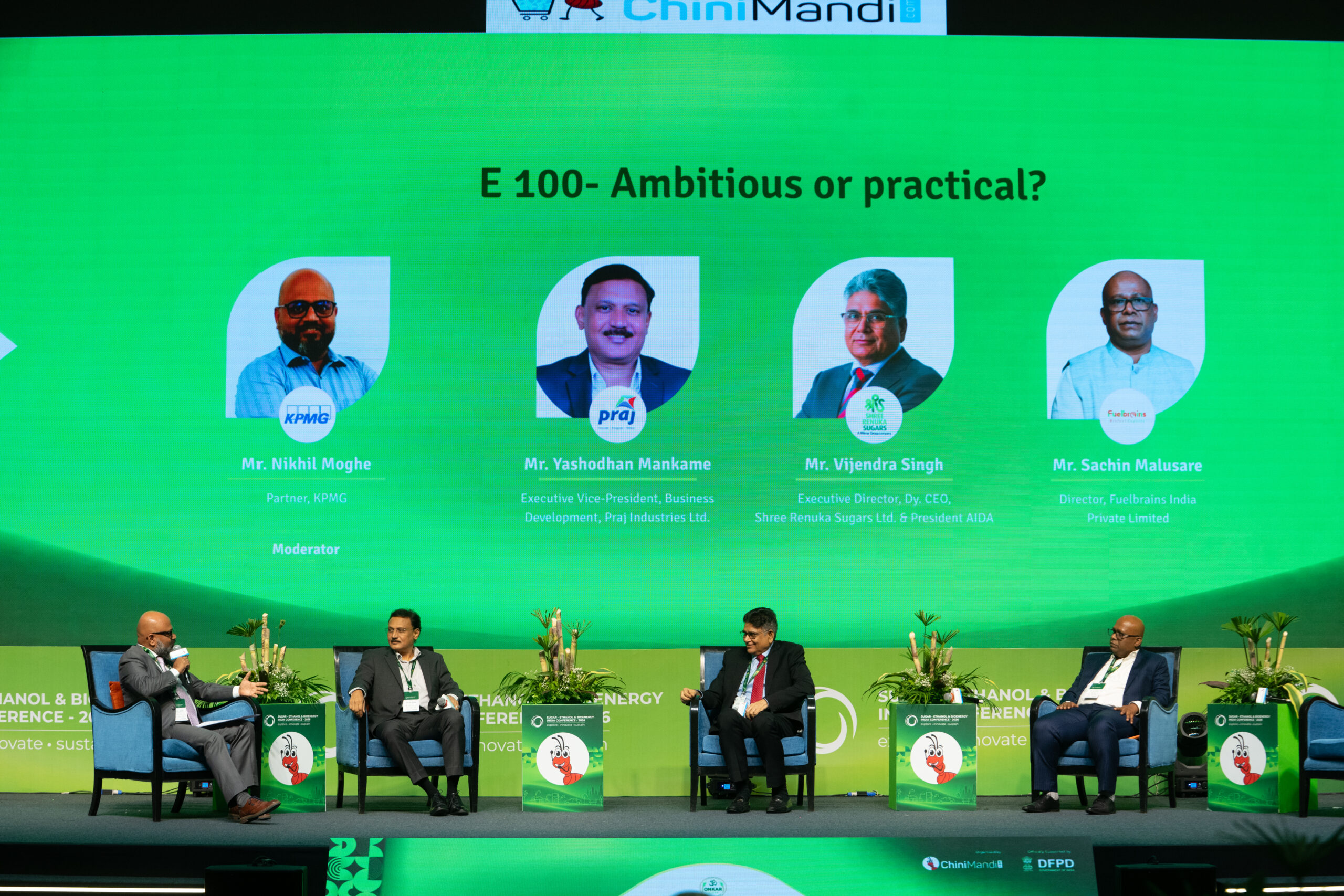
At the SEIC 2026, a panel discussion took place on “E100: Ambitious or practical”. Speaking at the session, Yashodhan Mankame, Executive Vice-President, Business Development, Praj Industries Ltd. said the transition from E20 to E100 cannot be viewed merely as a fuel switch.
“The transition from E20 to E100 requires the evolution of the entire ecosystem—from agriculture and feedstock availability to flex-fuel vehicle deployment, logistics infrastructure and technology development,” he said.

Mankame noted that first-generation (1G) ethanol technology has already matured, offering scalability and cost efficiencies. However, second-generation (2G) ethanol technologies are still evolving and may require additional time before widespread adoption.
“India has significant potential to adopt 2G ethanol technologies on a larger scale. The sugar industry itself is gradually transforming into a sugar biorefinery model. However, considerable work remains in ecosystem development,” he added.
He also stressed that E100 should be viewed as a complementary fuel rather than a complete replacement for petrol.
“Replacing petrol entirely is not going to happen. E100 will play a complementary role in the energy mix. We also need a robust carbon pricing framework and an active carbon market to support the transition,” Mankame said.
Drawing comparisons with Brazil, Vijendra Singh, President of the All India Distillers Association (AIDA), said India can learn valuable lessons from the world’s most successful ethanol economy.
“What Brazil achieved over several decades, India is trying to accomplish now,” Singh said.
He explained that Brazil’s ethanol industry operates in a deregulated, market-driven environment in which producers decide between sugar and ethanol production based on prevailing market conditions.
“In Brazil, consumers also have the freedom to choose between fuels depending on pricing. The government does not interfere in pricing decisions. The ecosystem is fully matured,” he said.
Singh noted that Brazil has aggressively expanded biodiesel blending and biogas production, while large-scale adoption of 2G ethanol remains limited.
He argued that India’s growing dependence on crude oil imports makes domestic biofuels strategically important.
“Our crude oil imports continue to rise every year. Any surplus sugar, rice or corn produced in the country should be used to replace imported fossil fuels. This will strengthen India’s energy security,” Singh said.
He further advocated a gradual phase-out of conventional petrol vehicles in favour of flex-fuel vehicles (FFVs) and electric vehicles (EVs), stating that such a move could significantly boost ethanol demand in the country.
However, scaling up ethanol consumption will require major investments in storage and logistics infrastructure, cautioned Sachin Malusare, Director, FuelBrains India Private Ltd.
“With E85 and E100, ethanol volumes will increase substantially, and moving those volumes will be a challenge,” Malusare said.
He pointed out that even today, ethanol producers often face delays in unloading due to inadequate infrastructure.
“Ethanol tankers are frequently waiting for decantation. We need larger tankage facilities, improved storage infrastructure and better logistics planning. Retail outlets also have limited storage capacity, which must be expanded before moving towards E100,” he said.
Malusare also highlighted the importance of consumer economics in driving adoption.
“E85 is cheaper than regular petrol, but consumers need to see a clear economic benefit. Incentives should be linked to energy-equivalent savings,” he said.
He cited Maharashtra’s electric vehicle policy as an example of how financial incentives can accelerate consumer adoption.
According to Malusare, retrofitting existing vehicles with flex-fuel kits could serve as a practical and cost-effective pathway to expand ethanol usage in the near term.
The moderator of the session was Nikhil Moghe, Partner, KPMG
To watch full discussion click here