
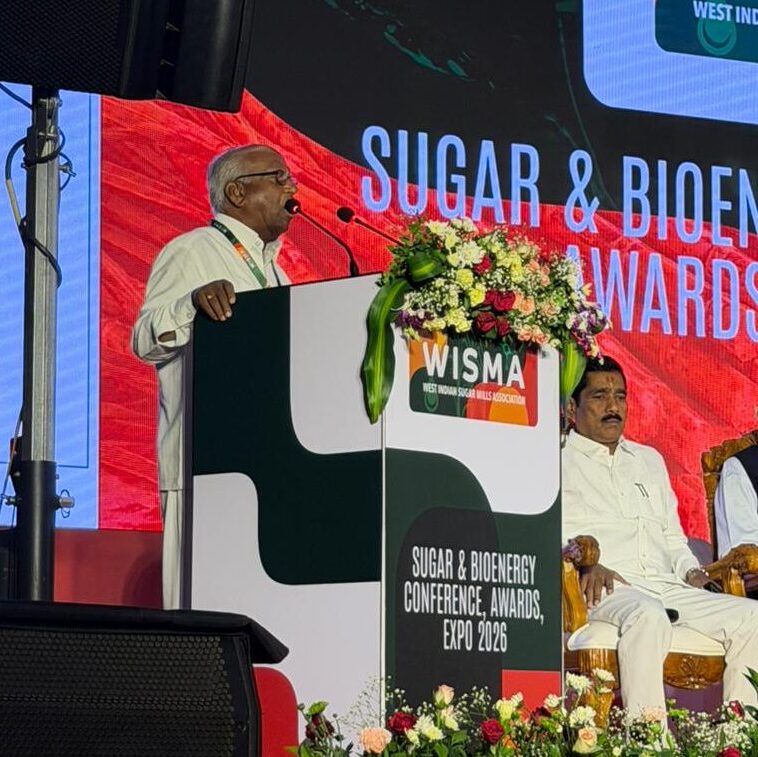
Pune: Maharashtra’s sugar industry must reinvent itself by moving beyond sugar production and embracing bio-energy, ethanol, Bio-CNG and green hydrogen to ensure long-term sustainability and farmer prosperity, WISMA president B.B. Thombre said on Saturday.
He was speaking at Sugar and Bioenergy Conference organised in Pune.

Addressing the cofnerence, Thombre said the industry’s future lies in converting sugar mills into integrated bio-energy hubs that can transform farmers from “food providers” into “energy providers”.
He said the private sugar sector in Maharashtra has witnessed remarkable growth since the industry’s de-licensing in 1998. From just five private sugar factories at the time, the state now has around 133 private sugar mills, which contribute nearly 55 per cent of Maharashtra’s sugar production, 60-65 per cent of power generation from sugar mills and 65-70 per cent of ethanol production.
Thombre stressed that there should be no distinction between cooperative and private sugar factories, as both ultimately work for the welfare of sugarcane growers and rural development. “Our common objective is the economic prosperity of farmers and the sugar industry,” he said.
Highlighting the sector’s evolution, he said sugar mills can no longer depend solely on sugar production. Global changes and the growing focus on renewable energy have created new opportunities through ethanol, Bio-CNG, green hydrogen and other value-added products.
Crediting Union Minister Nitin Gadkari for promoting the concept of bio-energy, Thombre recalled that Gadkari had advocated the production of Bio-CNG from sugar mill waste and ethanol from distillery operations long before such technologies became mainstream.
He noted that India’s ethanol blending programme, which began with a 5 per cent blending initiative under former Petroleum Minister Ram Naik, gained momentum after 2014 and has now reached 20 per cent blending. According to Thombre, the sugar industry’s current ethanol production capacity is sufficient to support even higher blending levels in the future.
He said Maharashtra has already established around 45 Bio-CNG projects using sugar mill waste, spent wash and press mud, while green hydrogen has emerged as the next major opportunity. Agricultural residues, sugar factory waste and biomass resources can all be utilised to produce green hydrogen, which is expected to play a major role in reducing carbon emissions and replacing fossil fuels.
Thombre also highlighted the growing role of technology in the sugar sector. He said artificial intelligence is being tested on nearly 5,000 sugarcane farms through initiatives led by the Vasantdada Sugar Institute and Baramati-based organisations, while AI applications are also being explored in sugar factory and distillery operations.
The seminar featured discussions on green hydrogen, Bio-CNG, carbon credits, bio-bitumen from agricultural waste and technologies that can improve the financial viability of sugar mills through better utilisation of by-products.
“The future of the industry depends on value addition. Sugar should become the by-product, while ethanol, Bio-CNG, green hydrogen and other bio-energy products should emerge as the main sources of revenue,” Thombre said.
He also urged policymakers to address key industry concerns, including sugar MSP, ethanol pricing and ethanol allocation, while ensuring that all sections of the sugar industry are represented in policy-making discussions.















Shri Thomare ji, I have the technology that does exactly what you describe here and is needed.i am a returning NRI from USA after 50 years. Let us move forward to get most value of all the sugarcane for benefit of farmers, Bharat, economy, environment, etc. Please contact me for way forward.