
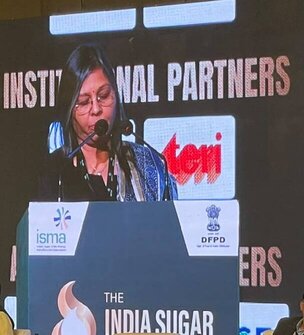
New Delhi: India’s sugar industry can use sugarcane and other domestic feedstocks to produce a wider range of biochemicals and reduce dependence on imported chemical products, Dr Sangeeta Srivastava, Executive Director, Godavari Bio Refineries, said at the Indian Sugar & Bio-energy Manufacturers Association (ISMA) conference 2026.
Srivastava said India should look beyond using sugarcane primarily for sugar and ethanol and focus on the carbon contained in the crop as a resource for producing fuels, chemicals and other value-added products. She said the country has the potential to develop integrated biorefineries capable of producing multiple products from different feedstocks.

She said the use of grain alongside sugarcane could further expand the range of products that can be produced. According to Srivastava, possibilities include polylactic acid (PLA), polyhydroxyalkanoates (PHA), lactic acid, xylitol, biofuels and biobutanol.
Srivastava said India had previously produced several bio-based chemicals, including biobutanol. Godavari Bio Refineries had been the first bio-based butanol producer in India, with production taking place in Barabanki, Uttar Pradesh, before it was discontinued around 1998. She also pointed to chemicals such as acetic acid, butanol and acetaldehyde that have been produced in India.
She said India’s strength lies in its combination of sunlight, agricultural resources and a large base of small farmers. Unlike countries where agriculture is dominated by larger farms, India’s bio-based industry must ensure that the value created from agricultural feedstock reaches farmers.
Srivastava stressed that traceability and responsible sourcing would become increasingly important as agricultural feedstocks are used to manufacture chemicals. Companies purchasing bio-based molecules are likely to seek information on the source of carbon, sustainability of the feedstock and how it was produced.
She said good agricultural practices, responsible treatment of farmers and labourers, and protection of soil health would therefore be essential for securing feedstock for the bio-based industry.
Srivastava said sugar mills could evolve into integrated biorefineries using different technologies and feedstocks. She cited opportunities in first-generation (1G) and second-generation (2G) ethanol, compressed biogas (CBG), green methanol from carbon dioxide and other products.
She also said ethanol should increasingly be viewed as a chemical feedstock rather than only as a transportation fuel. Ethanol can be produced from different sources, including 1G, 2G, 3G and 4G technologies, while gas fermentation and conversion of carbon dioxide could offer additional routes.
According to Srivastava, India imports around Rs 5,000 crore worth of ethanol-based chemicals, creating an opportunity for domestic producers to replace part of these imports. She cited ethanolamines, ethylene oxide and specialty chemicals based on acetaldehyde among the products that could be developed domestically.
She said India should move from a focus on energy security towards chemical security by producing more of the carbon-based products currently sourced from overseas. Instead of measuring sugarcane only in terms of tonnes of cane, the industry should consider the carbon contained in each tonne and explore ways to convert it into higher-value products.
Srivastava said moving up the value chain could generate significantly greater value than using the same feedstock only for fuel. She advocated a model in which companies work closely with farmers to develop feedstock and with customers to create products suited to market requirements.
She said commercial-scale integrated production could strengthen both feedstock and chemical security, while regenerative agriculture would be important for maintaining soil health and long-term feedstock availability.
Srivastava said Godavari Bio Refineries already produces several bio-based chemicals, including natural butylene glycol and vinyl ethers, which are used across industries such as pharmaceuticals, personal care and food and nutrition.
She called for a shift from an economy centred on oil towards one based on soil and renewable agricultural resources, saying India’s existing agricultural and industrial base could provide the foundation for greater chemical self-reliance.















