
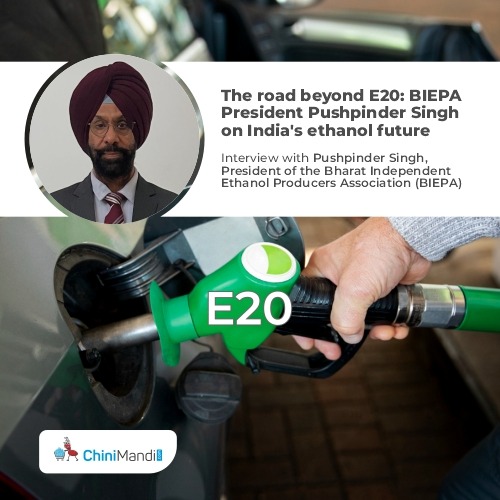
India has achieved its nationwide E20 petrol rollout ahead of schedule, but the next phase of the ethanol blending programme will require a clear roadmap towards E30, wider adoption of flex-fuel vehicles, stronger feedstock security and stable policy support, according to Pushpinder Singh, President of the Bharat Independent Ethanol Producers Association (BIEPA). In an interview with ChiniMandi, Singh discusses the priorities needed to sustain investment, improve capacity utilisation and strengthen India’s long-term biofuel ecosystem.
Q. India has successfully achieved nationwide E20 rollout ahead of schedule. What should be

the next milestone in the country’s ethanol blending programme?
In view of the Energy Security of our country and all other related benefits associated with Ethanol Blending like saving in Foreign Exchange, increase in farmers income, Environment benefits, Rural Development and learning from the other countries experience, I think the next mile stone in Country’s Ethanol Blending can be of Announcing a road map for making E-30 as our base fuel in next 5 years.
Q. With the E20 target achieved, what policy priorities should now take centre stage to sustain the momentum of India’s ethanol blending programme?
After achieving E-20 target following policy priorities should take centre stage:
(i) Penetration of flex fuel vehicles throughout the country. To achieve this, the price of vehicles will have to be made attractive for the consumers, at least initially, by way of reducing GST on such vehicles, reducing registration fee on such vehicles and keeping flex fuel prices like E-85 at least 30% lower than the normal base petrol price.
(ii) Secondly the use of Ethanol as a cooking fuel at least in Commercial and Community kitchens need to be promoted in a structured way to avoid foreign dependence on cooking gas.
(iii) Third policy priorities should be after successful trials, the roadmap for blending of Iso-butanol in Diesel should be expedited.
Q. As India looks to expand ethanol production, how can the country strengthen feedstock security through greater diversification while ensuring long-term sustainability?
As our requirement of Ethanol and production of Ethanol expands, the strengthening of the feed stock availability is equally important. We need to remove farm level inefficiencies, improve upon agricultural practices and introduce better quality and yields enhancing seeds. The yield of maize in the United States is about 11 quintals per acre as compared to 2.5-3 quintals per acre in India. So, there is big scope for improving the yields as well as the quality of feedstock.
Q. India has significantly expanded its ethanol production capacity in recent years. What are the key challenges in ensuring sustainable capacity utilization and attracting continued investments?
The key challenges in ensuring sustainable capacity utilization are first increasing the demand of Ethanol so that all the factories run minimum at 75% capacity utilization. The second aspect is related to availability and price of feedstock. More the availability and more competitive the price we can even compete with International Pricing of Ethanol.
Q. As President of BIEPA, what are the key priorities for the association in supporting the next phase of India’s ethanol and biofuel ecosystem?
The key priorities of Bharat Independent Ethanol Producers Association (BIEPA) are:
(i) Equable allocation to all Ethanol Producers so that every factory / investment is saved from becoming NPA.
(ii) Announcement of a roadmap for moving towards E-30 as base fuel and increased
acceptability and penetration of flex fuel vehicles capable of running at any blend
Ethanol without affecting the consumer’s pocket.
(iii) Announcing a road map for blending of Iso-butanol in diesel based on successful trials
which are already underway and pointing towards the success of Iso-butanol blending in
Diesel.
(iv) Allowing export of Ethanol to neighboring countries and also to allow sale of Ethanol
to the Chemical Industry, which is presently importing Ethanol for its use.
Q. How is BIEPA working with policymakers and industry stakeholders to address challenges faced by independent ethanol producers and strengthen the sector’s long-term growth?
BIEPA is in constant touch with the Policy makers through personal meetings and representations and apprising the authorities of the challenges faced by the Ethanol Producers. BIEPA is also suggesting various ways and means to address these challenges. These suggestions are being well accepted by the Policy Makers.
Q. The government has highlighted flex-fuel vehicles as an important part of India’s clean mobility vision. How prepared is the ethanol industry to support this transition?
The Ethanol Industry is fully prepared to support the transition to flex fuel vehicles. In fact the capacity of Ethanol Production has increased to more than 2000 crore litres against the requirement of 1200 crore litres at 20% blending in petrol. The capacity can be further enhanced in a very short period, as the demand grows. This has already been demonstrated by way of more than 1 lakh crore of investment in a short span of 3-4 years.















