

April 2026 is not just the start of a new financial year; it is also an important chapter in India’s energy story, as the country has taken a significant step toward cleaner mobility by rolling out E20 petrol nationwide. From April 1, 2025, petrol pumps across the country are required to supply fuel blended with up to 20 percent ethanol. According to a notification by the Ministry of Petroleum and Natural Gas, “The Central Government hereby directs that the oil companies shall sell Ethanol Blended Motor Spirit with percentage of Ethanol up to twenty per cent as per the Bureau of Indian Standards specifications and having minimum Research Octane Number (RON) of 95, in the States and the Union territories.”
It is worth pausing to appreciate the scale of what India has accomplished. The Ethanol Blended Petrol (EBP) Programme, which began with pilot projects in 2001 and was formally rolled out nationwide in 2003, gained renewed policy momentum after 2014 and has delivered remarkable results over the past decade. EBP Programme has resulted in expeditious payment to farmers to a tune of over Rs. 1,50,925 crore from Ethanol Supply Year (ESY) 2014-15 up to February 2026, besides savings of more than Rs. 1,70,560 crore of foreign exchange, net CO2 reduction of approximately 869 lakh metric tonne and substitution of more than 289 lakh metric tonnes of crude oil.

The Government have taken several measures to increase ethanol production in the country to achieve 20% blending of ethanol in petrol, which inter-alia includes expansion of feedstock for Ethanol production, administered price mechanism for Ethanol procurement under the Ethanol Blended Petrol (EBP) Programme, lowered GST rate to 5% for Ethanol for EBP Programme, introduction of various Ethanol Interest Subvention Schemes (EISS) during 2018-22, a dedicated subvention scheme for Cooperative Sugar Mills to convert existing sugarcane-based distilleries into multi-feedstock plants for ethanol production from molasses as well as grains, signing of 233 Long Term Offtake Agreements (LTOAs) between OMCs and Dedicated Ethanol Plants, allocation of 72 Lakh Metric Tonne (LMT) of surplus Food Corporation of India (FCI) rice for ethanol production for the ESY 2025-26, diversion of 40 LMT of sugar for ethanol production for the ESY 2024-25 and unrestricted production of ethanol from sugarcane juice/sugar syrup, BHeavy Molasses as well as C-Heavy Molasses for ESY 2025-26, notified the “Pradhan Mantri JI-VAN (Jaiv Indhan- Vatavaran Anukool fasal awashesh Nivaran) Yojana” to provide financial assistance for setting up Advanced Biofuels projects in the country using lignocellulosic biomass and other renewable feedstock, multimodal transportation of ethanol and increasing ethanol storage capacity along with other allied infrastructure for handling of higher blends of ethanol.
With an objective to broaden the scope of the scheme to incorporate Advanced Biofuels including Third Generation (3G) Ethanol, the Government has amended the PM JIVAN Yojana in 2024 to provide financial support for setting up Advanced Biofuels projects in the country using lignocellulosic biomass and other renewable feedstock. The PM JI-VAN scheme envisages setting up of about 12 commercial Advanced Biofuel Projects and about 10 demonstration scale Advanced Biofuel Projects. The purpose of supporting Demonstration projects is to enthuse Technology providers to display viability & performance of their novel technologies thereby indigenization of advanced biofuel technologies and to address, inter-alia, the challenge of higher conversion process cost of lignocellulosic biomass to ethanol as compared to the conventional molasses to ethanol process. Indian Oil Corporation Limited (IOCL) has established a 3G ethanol plant of 128 Kilo litre per day capacity at Panipat, Haryana, using refinery off-gas as feedstock, which is currently under stabilization.
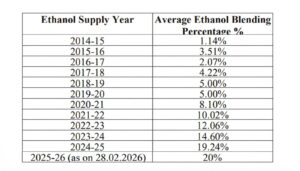
The National Policy on Biofuels – 2018, as amended in 2022, inter-alia, advanced the target of 20% blending of ethanol in petrol from 2030 to Ethanol Supply Year (ESY) 2025–26 (1st November, 2025 to 31st October, 2026). This target of 20% has been achieved in December, 2025 due to the concerted efforts of the Government that have led to increased ethanol blending with petrol from 38 crore litres in ESY 2013-14 to over 1000 crore litres in ESY 2024-25. That is a testament to what this nation can accomplish when government, industry, and agriculture move together.
The details of percentage of Ethanol blended with petrol by Public Sector Oil Marketing Companies (OMCs) under the EBP Programme from 2014-15, ESY-wise, is as under:
The timing could not be more significant. With geopolitical tensions keeping global crude oil markets volatile and India importing around 90% of its crude oil needs, every percentage point of ethanol displacing petrol at the pump represents real energy security.
The environmental gains of ethanol are equally real: higher octane, cleaner combustion, and lower particulate emissions in cities that are already battling air quality challenges.
Even as the E20 mandate takes effect, India’s ethanol and sugar industry is looking beyond it with both urgency and confidence. India’s ethanol production capacity has reached around 2,000 crore litres and is expected to rise by about 10% more from projects in the pipeline, while the current requirement at 20% blending stands at about 1,300-1,400 crore litres, including roughly 1,200-1,250 crore litres from oil marketing companies (OMCs). This surplus is not a problem to manage but an opportunity to seize.
Industry bodies have been vocal on this point, urging the government to consider blending targets of E22, E25, and eventually E30 to absorb excess supply and reduce crude imports further.
The path forward is technically sound and economically justified. What the industry now needs is a clear and committed policy signal with explicit timelines, long-term procurement contracts, and a technology roadmap for high-blend vehicles and Flex-Fuel Vehicles.
India’s ethanol programme has become a global reference point. The Nepal government has implemented a new policy aimed at introducing ethanol-blended petrol. According to the policy, the Nepal Oil Corporation (NOC) must mix up to 10 percent ethanol in a liter of petrol, depending on availability. The policy aims to promote industries based on domestic raw materials, create employment opportunities, encourage the use of agricultural and biological resources, and reduce energy imports. This initiative had been under discussion for nearly two decades, and India’s example finally helped tip it into action. A neighbour that imports all its petrol from India is now inspired to build its own domestic ethanol ecosystem. That is the power of demonstrating something at scale.
The US Environmental Protection Agency (EPA), in consultation with the Department of Energy and under the Clean Air Act, has issued a temporary emergency fuel waiver allowing the nationwide sale of E15 gasoline, a blend containing 15% ethanol, and removing federal impediments to E10 sales. The waiver, announced by EPA Administrator Lee Zeldin, is aimed at strengthening the domestic gasoline supply chain and providing relief to consumers ahead of the summer driving season. The agency stated that the move would help prevent disruptions in fuel supply while expanding consumer choice at the pump.
Argentina has authorized fuel producers to voluntarily blend up to 15% ethanol into gasoline to help ease rising local fuel costs caused by global oil price shocks. The measure aims to give the industry greater flexibility and to cushion any potential increases in pump fuel prices, protecting consumers.
Maize has emerged as the single largest feedstock in Ethanol Supply Year 2024-25, contributing nearly 50% of total ethanol supply. This is a structural shift that could permanently reshape India’s biofuel landscape, reducing dependence on sugarcane alone and strengthening the programme’s long-term resilience. As India moves toward higher blends, this feedstock flexibility will be crucial to sustaining momentum without compromising food security.
However, the surplus capacity that exists today must not become a source of distress. According to producers, underutilisation has already created financial pressure for sugar mills and distilleries, leading to delayed payments to farmers and weakened rural incomes.
Higher blending targets, combined with Flex-Fuel Vehicle mandates, incentivised infrastructure at retail outlets, and rational pricing, are the most effective tools to keep the momentum alive and reward the investments already made.
The fuel crisis the world is facing today will not resolve itself. The solution has to be homegrown, renewable, and scalable, and India has already proven that it is possible. The next decade must be about going further, toward E30 and beyond, because the case for doing so has never been stronger and the foundation to build on has never been more solid.
For further inquiries or to contact Uppal Shah, Editor-in-Chief, please send an email to uppal@chinimandi.com.















