
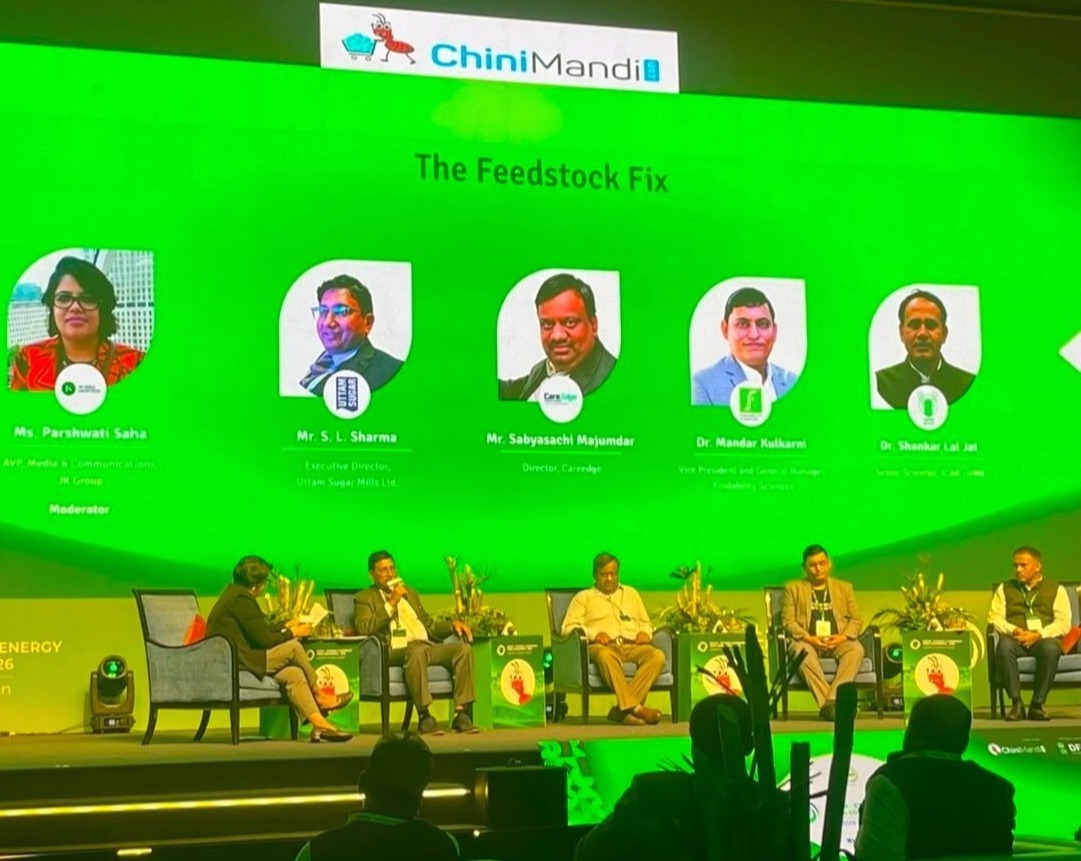
Mumbai: As India expands its ethanol blending ambitions and diversifies its bioenergy ecosystem, industry leaders and experts called for a balanced approach to feedstock selection, greater use of technology and improved agricultural productivity during a panel discussion titled “The Feedstock Fix” at the Sugar Ethanol Bioenergy India Conference (SEIC) 2026.
The discussion explored critical issues shaping India’s ethanol future, including uniform ethanol pricing irrespective of feedstock, the growing role of maize, the food versus fuel debate, utilisation of existing production capacity and the potential of artificial intelligence (AI) in identifying the most efficient feedstock mix for ethanol production.

Opening the discussion, S. L. Sharma, Executive Director, Uttam Sugar Mills Ltd, addressed concerns around increasing preference being given to maize in the ethanol programme and stressed the importance of maintaining a balanced approach.
Sharma said that while maize has gained prominence in recent years, both maize and sugarcane remain important for achieving India’s ethanol blending targets.
“Maize is being given preference over sugarcane. For the ethanol blending programme, both maize and sugarcane are required and it won’t affect the ethanol blending programme,” he said.
He emphasised that improving productivity rather than creating competition between crops should be the focus.
“We should concentrate on productivity of sugarcane and maize to boost farmers’ income,” Sharma added.
Offering a broader energy perspective, Sabyasachi Majumdar, Director, CareEdge, said India’s strength lies in having multiple feedstock options and that long-term sustainability would depend on developing all available energy sources simultaneously.
Majumdar said diversified feedstocks reduce risk and improve resilience in the energy ecosystem.
“We have diversified feedstocks. We have to equally develop all energy resources and we need to promote farm-based energy to become self-sustainable,” he said.
He added that technology adoption would play a decisive role in reducing the cost of green energy production and improving economic viability.
Bringing in the technology perspective, Dr Mandar Kulkarni, Vice President and General Manager, Findability Sciences, highlighted the growing role of artificial intelligence in transforming agriculture and industrial operations.
Kulkarni said AI applications in the sugar sector have already moved beyond experimentation.
“Since the last five years, we are using AI in the sugarcane sector. We have created models for the sugar and manufacturing sector,” he said.
Describing AI as a decision-support tool rather than a replacement for human expertise, he added, “AI is co-pilot, human is pilot.”
According to Kulkarni, data-driven systems can support better decision-making in areas such as irrigation management, operational efficiency and resource conservation, particularly water management.
Addressing the agriculture and feedstock dimension, Dr Shankar Lal Jat, Senior Scientist, ICAR–Indian Institute of Maize Research (ICAR-IIMR), stressed the importance of raising productivity through scientific interventions.
He said the focus should remain on mechanised planting, effective weed management and water conservation.
“Produce more from less,” Jat said, underlining the need for efficiency-led growth.
On the ongoing food-versus-fuel debate, he noted that different feedstocks serve different purposes and require separate policy approaches.
“Prices of different feedstocks are different. Food versus fuel debate is always there. Rice and wheat are food crops while maize is an industrial crop,” he said.
Jat also invited industry stakeholders to collaborate with research institutions to address operational and feedstock-related challenges.
The session was moderated by Parshwati Saha, AVP – Media & Communications, JK Group.
The discussion reflected the growing consensus that India’s ethanol growth story will depend not on a single feedstock but on a diversified, technology-driven and resource-efficient approach that balances farmer incomes, energy security and sustainability goals.
To watch full discussion click here















