India’s energy landscape is undergoing a decisive structural transformation, shifting from a reliance on volatile global commodity markets toward indigenous, sustainable fuel sources. The Ethanol Blending Programme (EBP20) has already served as a masterclass in industrial policy, demonstrating how clear regulatory frameworks and technological readiness can achieve national energy self-reliance. By successfully scaling ethanol blending in the petrol segment, India has established a blueprint for decarbonization that is now being directed toward its most critical energy challenge: the diesel economy. This transition is not merely an environmental mandate but a strategic necessity to insulate the national economy from geopolitical shocks.
The roadmap for this evolution lies in bridging the gap between India’s robust agricultural surplus and its burgeoning transport and industrial fuel requirements. Through the development of indigenous technologies and the emergence of bio-isobutyl alcohol (Bio-IBA), India is positioned to leverage its agricultural base to power transport and heavy industry. This represents the next phase of the national biofuel revolution, moving beyond light-vehicle petrol blending to tackle the heavy-duty applications that form the backbone of the nation’s GDP. The transition is not devoid of challenges, given the sheer scale and ubiquity of diesel dependency across the subcontinent.

Diesel remains the primary lifeblood of the Indian economy, serving as the essential fuel for freight, mass transit, and heavy industry. According to data from the Petroleum Planning & Analysis Cell (PPAC), India’s diesel consumption reached approximately 91.4 million tonnes (roughly 110 billion litres) in FY 2024–25. With a steady annual growth rate of 2%, the scale of the challenge is visceral: India must find a way to meet roughly 1.8 million tonnes of additional diesel demand every single year.
Distribution of diesel consumption underscores its critical role across multiple strategic sectors: Source PPAC
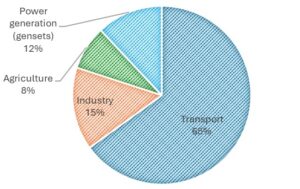
From a policy perspective, the “So What?” of this data is undeniable. Relying solely on imported fossil fuels to satisfy an annual demand increase of 1.8 million tonnes is fiscally unsustainable and a risk to national productivity. Urban air pollution and the associated public health costs further necessitate an immediate, scalable biofuel alternative. The solution requires a technological pathway that mirrors the modular success of the EBP model, providing a seamless transition for existing industrial infrastructure.
Bio-isobutyl alcohol (Bio-IBA) has emerged as the transformative “bolt-on” solution for the Indian biofuel market. Unlike greenfield energy projects that require massive capital outlays and years of lead time, Bio-IBA technology is designed to integrate with India’s existing first-generation (1G) ethanol infrastructure. This model is a strategic breakthrough, allowing producers to leverage established assets and supply chains without the burden of redundant infrastructure investment.
The technological readiness of Bio-IBA is the result of a decade of dedicated research and development, which has seen a significant acceleration in momentum over the past two years. Pioneered by Praj Industries, the technology has been optimized for Indian sugary and starchy feedstocks, moving rapidly from the laboratory to commercial-scale demonstration.
Critically, Bio-IBA serves as a vital “de-risking mechanism” for sugar mills and distilleries. It offers “optionality”—the ability to pivot production between ethanol and Bio-IBA based on real-time market demand.

The adoption of any new fuel pathway depends on industry buy-in and the validation of performance in real-world conditions. For Bio-IBA, the proof of concept is already being established in high-demand static and industrial applications. Industry leaders are validating that Bio-IBA is a high-performance fuel capable of meeting the rigorous standards of heavy machinery. A significant milestone in this validation process was highlighted by Ms. Gauri Kirloskar, Vice Chairperson and Managing Director, Kirloskar Oil Engines Limited (KOEL): “KOEL has demonstrated the performance of gensets operating on 100% bio-IBA, with results indicating stable and comparable performance. This highlights the potential of bio-IBA not only for transportation but also for stationary applications such as power generation. We look forward to further ecosystem development, including supportive policies, supply chain readiness, and broader industry alignment to enable its adoption at scale.”
The strategic implications of this statement are profound. Achieving 100% compatibility in static applications such as power generation proves that Bio-IBA is a “drop-in” fuel. By maintaining hardware compatibility, Bio-IBA offers a frictionless path to decarbonizing industrial sites, construction zones, and mining operations, signaling a massive opportunity for India Inc. to reduce its carbon footprint without sacrificing operational efficiency.
The drive toward Bio-IBA is deeply rooted in the strategic imperative of “Atmanirbhar Bharat” (Self-Reliant India). In an era of heightened geopolitical uncertainty, domestically developed fuel pathways are essential for reducing the Current Account Deficit (CAD) and shielding the economy from global oil price volatility.
 Dr. Pramod Chaudhari, Founder Chairman of Praj Industries, emphasizes the strategic weight of this transition: “Bio-IBA demonstrates strong technological readiness as a diesel-compatible renewable fuel, enabled through a bolt-on production model and proven fermentation routes. In the current geopolitical environment, such domestically developed fuel pathways are critical for strengthening energy self-reliance. It also enables higher-value utilisation of agricultural feedstocks.”
This shift transforms agricultural “excess”—which often leads to price crashes—into industrial “assets.” By creating a reliable demand for sugary and starchy crops for diesel blending, the Bio-IBA pathway establishes a “market-decoupled price stabilization” for the farming community. This ensures that farmers have a guaranteed high-value industrial outlet for their produce, strengthening rural value chains and providing a sustainable economic floor. Furthermore, Bio-IBA serves as a critical intermediate for sustainable aviation fuel (SAF) pathways, positioning India to lead the next generation of global renewable fuels while securing its own energy borders.
India is no longer just contemplating a transition away from fossil-fuel-dependent diesel; the nation is actively building the infrastructure to make a multi-fuel future a reality. By replicating the success of the Ethanol Blending Programme and applying it to the diesel sector through modular, domestic technologies like Bio-IBA, India Inc. is securing its energy sovereignty.