
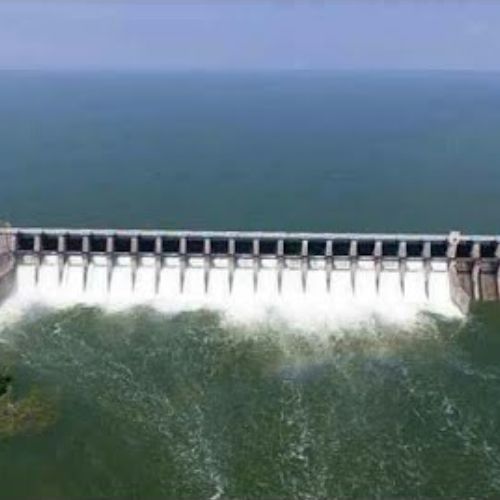
The Irrigation Consultation Committee (ICC) on Saturday decided to release water from the Krishna Raja Sagar (KRS) dam for standing perennial sugarcane crops beginning May 12, with the release period of up to 15 days subject to pre-monsoon rainfall, Deccan Herald reported, citing officials of the Cauvery Neeravari Nigam (CNN).
CNN officials confirmed that while the KRS dam’s water level stood at 92.70 ft against its full capacity of 124.80 ft on Saturday, the reservoir holds sufficient storage to meet drinking water needs for Mysuru and Bengaluru districts through to June-end, by which time the south west monsoon is expected to arrive. The dam is situated in Srirangapatna taluk of Mandya district.

The drinking water requirement for both districts is approximately 2 tmcft per month, officials said. They added that around 300 cusecs per day would also be released into the river for environmental reasons in the event of no rainfall.
CNN had commenced irrigation releases from July 2025. Releases were suspended between December 16 and 22 before resuming for paddy crops, standing sugarcane crops, and tank filling until January 3, 2026. Following an ICC meeting in January, the agency released water for standing perennial sugarcane crops from January 12 in an 18-days-on and 12-days-off cycle, completed across four rounds through the end of April.
The KRS dam is the primary irrigation source for 3,39,136 acres of farmland across Mysuru and Mandya districts. Of this, 1,95,972 acres are served by the Visvesvaraya Canal, 63,164 acres by the Anekat group of canals — which includes the Chikkadevaraya, Devaraya, Virija, Banagaradoddi, Rajaparameshwari, Ramaswamy, and Madav Mantri canals — and 80,000 hectares under the D Devaraja Urs/Varuna canal.
As of May 2, all reservoirs in the Cauvery river basin together held 44.50 tmcft of water, or 39 per cent of their combined gross capacity of 114.57 tmcft. KRS held 17.61 tmcft, at 36 per cent of its full capacity of 49.45 tmcft. Kabini stood at 6.35 tmcft (33 per cent of 19.52 tmcft), with a water level of 2,257.28 ft against its full depth of 2,284 ft. Hemavathi held 17.34 tmcft (47 per cent of 37.10 tmcft), with the level at 2,895.84 ft against a capacity of 2,922 ft. Harangi recorded 3.20 tmcft (38 per cent of 8.50 tmcft), with a level of 2,827.29 ft against 2,859 ft.
On the same date last year, the combined storage across these reservoirs was 50.65 tmcft. KRS held 19.07 tmcft at a level of 94.89 ft; Kabini had 9.05 tmcft at 2,264.28 ft; Hemavathi held 19.09 tmcft at 2,898.95 ft; and Harangi had 3.44 tmcft at 2,831.90 ft — indicating that current storage levels across all four dams trail the corresponding figures from a year earlier.















