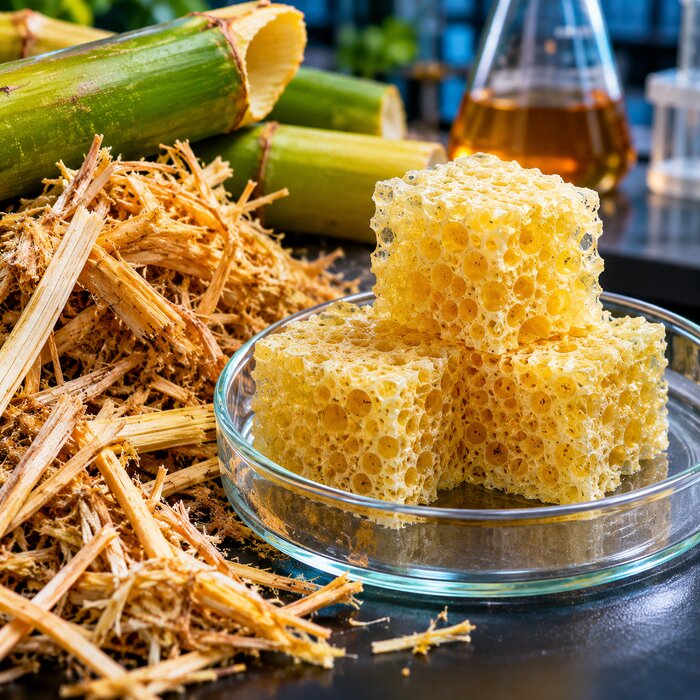
Researchers have demonstrated that highly porous bio-based gels can be made from sugarcane bagasse and sugarcane straw, using a lignin extraction process that mimics industrial kraft pulping followed by hydrothermal cross-linking. The work points to a higher-value use for sugarcane residues within circular biorefineries.
The team produced two types of gel, cryogels and xerogels, with renewable material content of more than 70 per cent. The cryogels reached porosity of up to 73.04 per cent. According to the study, this is among the first uses of sugarcane straw lignin alongside bagasse for this purpose. The researchers said the gels can serve as precursors for advanced porous carbons and show that crop residues can replace petrochemical ingredients in functional gel manufacturing. The research article in this regard has been written by Giovani Maltempi-Mendes, Gisele Aparecida Amaral-Labat, Gwilherm Kerherve, Anuj Kumar Chandel has been published in Spring Nature.

The study found that adding small amounts of nickel sulphate sped up the formation of the polymer network. For lignosulphonate formulations, which are harder to process, this cut synthesis time from 24 hours to six hours.
Global sugarcane cultivation generates an estimated 495 million dry tonnes of lignocellulosic residue a year, the study noted. Bagasse, the fibre left after the stalks are crushed, is usually burned as fuel in mills or used for pulp and paper. Sugarcane straw, or field trash, is mostly left on harvested fields to protect the soil and recycle minerals.
According to the researchers, lignin makes up 19 to 32 per cent of bagasse and 17 to 41 per cent of sugarcane straw. They said more than 60 per cent of commercially recovered industrial lignin is burned as low-grade boiler fuel. Turning lignin into structured materials has been difficult because it is chemically resistant, varies in composition and contains a lot of inorganic ash.
For the study, unwashed bagasse and straw were sourced from Usina Ipiranga Agroindustrial in Descalvado, São Paulo, Brazil. Lignin was removed in laboratory-scale rotary digesters designed to simulate industrial kraft pulping. This alkaline process uses sodium hydroxide and sodium sulphide at high pressure and temperature. The researchers used nine per cent active alkali, based on the dry mass of the feedstock, and 25 per cent sulphidity, conditions that earlier studies had found gave better lignin extraction.
Lignin was then recovered from the resulting black liquor by precipitating it with sulphuric acid at lower pH. Compared with precipitation using carbon dioxide, this recovered up to 2.7 times more lignin from bagasse and twice as much from straw.
Analysis showed that straw lignin contained 82.84 per cent lignin and 10.02 per cent carbohydrates, with ash content of several per cent, mostly silica. Bagasse lignin contained 70.05 per cent lignin and 24.68 per cent residual carbohydrates. The researchers said the findings offer a practical way to add value to sugarcane trash and bagasse within circular biorefinery systems.