
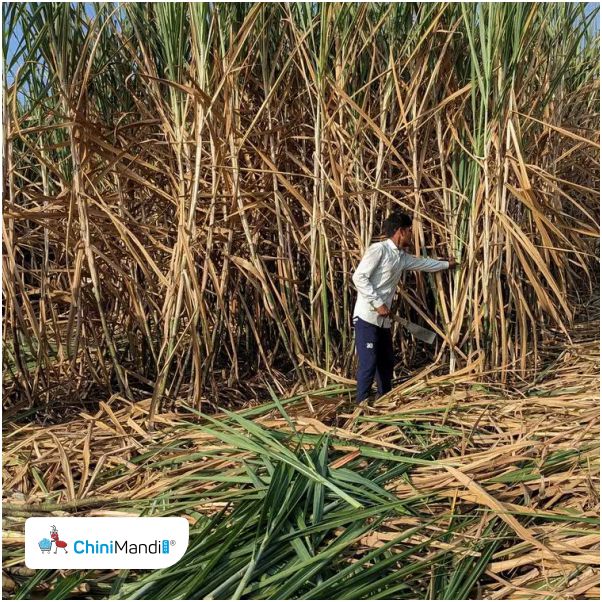
Basti: A sugarcane variety developed by a progressive farmer from Uttar Pradesh’s Basti district has received official protection from the Government of India, paving the way for wider distribution among farmers and commercial cultivation in the coming years.
The new variety, named “Captain-Basti,” was developed by farmer Agyaram Verma and is being recognised for its higher yield potential, improved sugar recovery and stronger resistance to red rot disease compared with conventional sugarcane varieties, Amar Ujala reported.

Verma, a resident of Kharka Devari village in the Kaptanganj area of Basti, began working on the variety in 2010 after receiving training from the Krishi Vigyan Kendra in Basti. After five years of field trials and experimentation, he successfully developed the new sugarcane variety in 2015.
An application for registration was submitted on August 6, 2015. Following a process that took nearly eleven years, the variety received approval on May 6, 2026.
According to Verma, the protection granted to the variety will remain valid until May 5, 2041. During this period, no individual, company or institution will be allowed to produce, market, distribute or export the seed material of the variety without his approval.
One of the key features of Captain-Basti is its production capacity. The variety is claimed to deliver yields of 1,400 to 1,600 quintals per acre, compared with 700 to 800 quintals per acre from conventional sugarcane varieties, offering the possibility of significantly higher output for farmers.
The variety is also considered more resistant to red rot disease, reducing the risk of crop losses and helping maintain production stability. It is reported to perform well under lower irrigation conditions and with regular fertiliser use, potentially reducing cultivation costs while improving profitability.
The sugarcane plants are described as taller, stronger and heavier, contributing to higher field productivity.
Captain-Basti has recorded a sugar recovery rate of 12.5 per cent, purity of 88 per cent and a juice score of 65, making it potentially attractive for sugar mills as well.
Experts explain that developing a new sugarcane variety involves selecting two or three strong parent varieties and growing them together. During flowering, pollination takes place through insects and wind, producing mixed seeds from which superior plants are selected and further developed.
Verma said seed material of the new variety is expected to be made available to farmers for planting across 15 to 20 acres by 2027. He added that farmers are regularly encouraged to adopt improved varieties and modern cultivation practices to strengthen farm incomes.
The variety had earlier received recognition in 2020 with the Jagjivan Ram Innovative Farmer Award for its ability to deliver better output at lower production cost.
Over the years, Verma has also been honoured by the Chief Minister, Governor, Agriculture Minister and the Prime Minister for his contributions to agriculture.















