
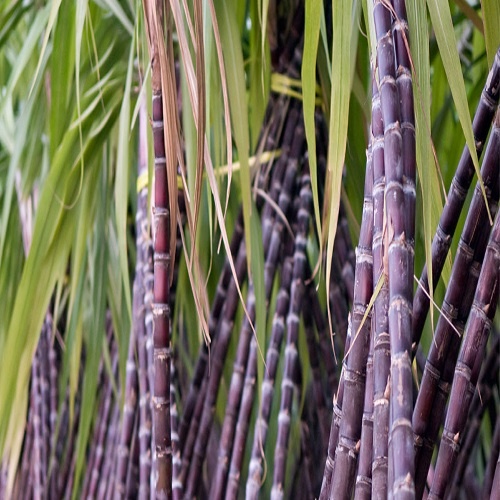
India’s largest sugarcane-producing state, Uttar Pradesh, has witnessed a sharp decline in sugar output as red rot disease continues to affect Co-0238, also known as Karan 4, the once-dominant sugarcane variety. The industry is now looking to newly developed varieties to restore cane productivity and sugar recovery, reported the Indian Express.
The state’s sugar production has fallen sharply from a peak of 126.37 lakh tonnes (LT) in 2019-20 to 89.52 LT in 2025-26. Over the same period, cane crushing declined from 1,118.02 LT to 878.12 LT, a fall of nearly 22%. Sugar recovery, meanwhile, dropped from 11.73% to 10.83%. The figures underline the impact of declining cane productivity on the state’s sugar industry as the once-dominant Co-0238 variety comes under increasing pressure from red rot.

The sugar industry is now pinning its hopes on Co-20016, also known as Karan 20, developed by the Indian Council of Agricultural Research’s Sugarcane Breeding Institute (ICAR-SBI). The variety was identified as a potential replacement for Co-0238 by the Varietal Identification Committee under the All-India Coordinated Research Project (AICRP) on Sugarcane at its May 27 meeting.
Co-20016 is expected to be placed before the Central Varietal Release Committee in October. Subject to approval and official release, farmers could begin cultivating it during the spring, summer or autumn planting seasons.
In August 2023, the Indian Sugar & Bio-energy Manufacturers Association (ISMA), in collaboration with ICAR-SBI, launched trials to evaluate improved sugarcane varieties across India’s subtropical and tropical growing regions.
In the subtropical region, Co-20016 and Co-21012 underwent three years of evaluation involving two plant-cane crops and one ratoon crop. Sixteen sugar mills participated in the trials, including 11 in Uttar Pradesh.
ISMA Director-General Deepak Ballani said trials of both varieties had been completed, with encouraging results. AICRP trials for Co-20016 have also concluded, while those for Co-21012 are still underway.
Co-20016 recorded an average cane yield of 144.6 tonnes per hectare during ISMA’s three-year trials, compared with 116.4 tonnes for Co-0238. Its average sucrose content after 10 months of growth was also higher at 18.7%, against 18.3% for the older variety.
More importantly, Co-20016 demonstrated resistance to CF13, a highly virulent pathotype of *Colletotrichum falcatum*, the fungus responsible for red rot.
Co-0238, released in 2009, initially transformed sugarcane cultivation in Uttar Pradesh. Its share of the state’s cane acreage increased to 82.2% by 2019-20 and reached 86.7% in 2020-21.
The variety’s thicker stalks, higher yields and early maturity benefited both farmers and sugar mills. Average cane productivity increased from below 60 tonnes to more than 80 tonnes per hectare, while its high sucrose content helped mills achieve better sugar recovery throughout the crushing season.
However, its widespread cultivation also increased the industry’s vulnerability to disease.
Bakshi Ram, former director of ICAR-SBI and breeder of Co-0238, attributed the variety’s declining resistance to prolonged monoculture, which contributed to the emergence of the more aggressive CF13 pathotype.
He had previously cautioned against excessive cultivation of Co-0238, particularly in central, eastern and Terai regions of Uttar Pradesh, where waterlogging creates favourable conditions for red rot infestation and the spread of fungal spores.
Ram emphasised the need for greater varietal diversification, suggesting that no single sugarcane variety should occupy more than 40-50% of the cultivated area in any growing region.
Alongside Co-20016, the industry is evaluating Co-21012 as another potential replacement for Co-0238.
ISMA trials recorded an average cane yield of 129.4 tonnes per hectare for Co-21012, compared with 119.7 tonnes for Co-0238. Its sucrose content was also marginally higher at 18%, against 17.8% for the older variety.
However, its resistance to red rot, particularly the CF13 pathotype, will be assessed after the completion of AICRP trials, expected in mid-2027.
The ultimate success of both varieties will depend on their performance under actual farming conditions.
The impact of red rot is already forcing some farmers to reduce sugarcane cultivation. Jitender Singh Hooda, a farmer from Kheri Bairagi village in western Uttar Pradesh’s Shamli district, reduced his cane acreage from eight acres to six in 2025 and further cut it to four acres in 2026.
He has shifted the remaining land to maize, urad and short-duration Pusa-1509 basmati paddy. Hooda said his sugarcane yields had fallen from 38-39 tonnes per acre to just 22-23 tonnes, with red rot significantly eroding farmers’ confidence in the crop.















